Share the page
IUCN and the French Facility for Global Environment renew their support for North African civil society
Published on
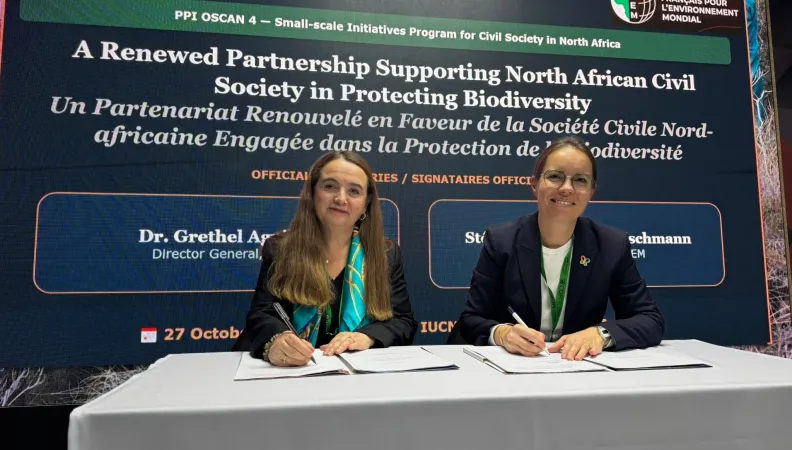
Signed at COP17, the new agreement provides €2 million over five years to fund conservation projects and strengthen the capacities of at least 40 civil society organisations in Morocco, Tunisia, Libya and Egypt.
Erevan, Arménia, 27 October 2026 (UICN) : The International Union for Conservation of Nature (IUCN) and the French Facility for Global Environment (Fonds français pour l'environnement mondial, FFEM) signed today the financing agreement for the fourth phase of the Small Initiatives Programme for Civil Society Organisations in North Africa (PPI-OSCAN). The signing ceremony took place at the IUCN Pavilion on the sidelines of the 17th Conference of the Parties to the Convention on Biological Diversity (COP17), in the presence of Dr Grethel Aguilar, IUCN Director General, and Stéphanie Bouziges-Eschmann, Secretary General of the FFEM.
Coordinated by the IUCN Centre for Mediterranean Cooperation (IUCN Med), PPI-OSCAN was launched in 2014 with the support of the FFEM and the MAVA Foundation. The programme combines small grants with long-term support, including organisational development, technical training, networking and dialogue with public authorities. The fourth phase, supported by €2 million in co-financing from the FFEM over five years, will assist at least 40 civil society organisations (CSOs) in Morocco, Tunisia, Libya and Egypt.
More than a decade of results on the ground
Over its first three phases, the programme supported 90 CSOs through 110 projects in Algeria, Libya, Morocco, Tunisia and Egypt, with participating countries varying across phases. These projects have helped protect species, restore ecosystems and generate benefits for local communities. Eleven of the supported NGOs have since become IUCN Members: five in Tunisia, four in Libya and two in Morocco.
In Tunisia, IRADA, an association that is now an IUCN Member, brought together organisations from across the region to work on oasis conservation and resilience, with support from the programme. In Morocco, cooperation between conservation associations and the National Agency for Water and Forests to protect birds of prey demonstrates how the programme helps build closer ties between civil society and public institutions. Environment ministries and national authorities in participating countries are also involved in this approach, helping to align local projects with national conservation priorities.
Since 2014, the French Facility for Global Environment (FFEM) has supported civil society organisations working for nature conservation in North Africa, through our Centre for Mediterranean Cooperation. The value of this support goes beyond a grant: training and long-term accompaniment have enabled these organisations to strengthen their governance, manage their resources effectively, and collaborate with larger partners. Today’s signing marks a new milestone in our partnership, and I thank the FFEM for supporting Phase 4 of the Small-Scale Initiatives Programme for Civil Society Organisations in North Africa (PPI-OSCAN 4),” said Dr Grethel Aguilar, Director General of IUCN. “Civil society organisations are at the heart of our Union. Strengthening their capacities means strengthening local conservation efforts and their contribution to our shared mission.”
A fourth phase focused on learning and networking
The new phase places greater emphasis on organisational development, with increased opportunities for peer-to-peer learning, mentoring, knowledge exchange and knowledge management. It will also strengthen the programme's presence in Egypt, following an initial pilot phase.
PPI-OSCAN 4 will also contribute to strengthening Mubadarat, IUCN Med's platform for Mediterranean civil society organisations. The platform brings together PPI-OSCAN and other IUCN programmes and initiatives that provide CSOs with funding, technical assistance and opportunities to collectively influence public policies beyond individual projects.
For this fourth phase, one of our objectives is to support the scaling up of both the solutions and the organisations themselves, which requires diversifying their sources of funding. In this regard, IUCN Med’s Mubadarat initiative will help ensure a continuum of support for civil society organisations,” said Stéphanie Bouziges-Eschmann, Secretary-General of the FFEM.
Public funding and private philanthropy
Cooperation between IUCN Med and the FFEM in the Mediterranean extends beyond PPI-OSCAN to sustainable blue tourism, ecosystem restoration and efforts to tackle plastic pollution.
Philanthropic funding has supported PPI-OSCAN since its inception. The MAVA Foundation co-financed the programme alongside the FFEM, a role now taken over by a Swiss foundation. The programme thus illustrates how public funding and private philanthropy can work together to advance nature conservation.